For this case study relating to genre theory, I have decided to analyse two contrasting videos and the ways in which they either use the theory of genre or deviate from it and where they share similarities or differences. The reason for using two videos is that I felt not all videos display genre theory in an explicit way; pop videos are very different from art house productions, although both do show theories of genre, just in different ways. Generic videos, like many pop/rap videos, exhibit theories relating to mass audiences and commercialism, whereas art house productions tend to explore the concept of genre and its intertextuality with other productions. To show this contrast, I have chosen to use the music videos for 'ASAP Rocky - Peso' and 'Jackson and His Computer Band - Dead Living Things'.
Artist/Band: Jackson & His Computer Band
Track Name: Dead Living Things
Genre: Electro-house, electro-rock, French touch
Release Date: Album 'Glow' released on the 2nd of September 2013
Label: Warp Records
Artist/Band: ASAP Rocky
Track Name: Peso
Genre: Rap, Hip Hop
Release Date: November the 16th, 2011
 |
| Opening title for 'Dead Living Things' |
 |
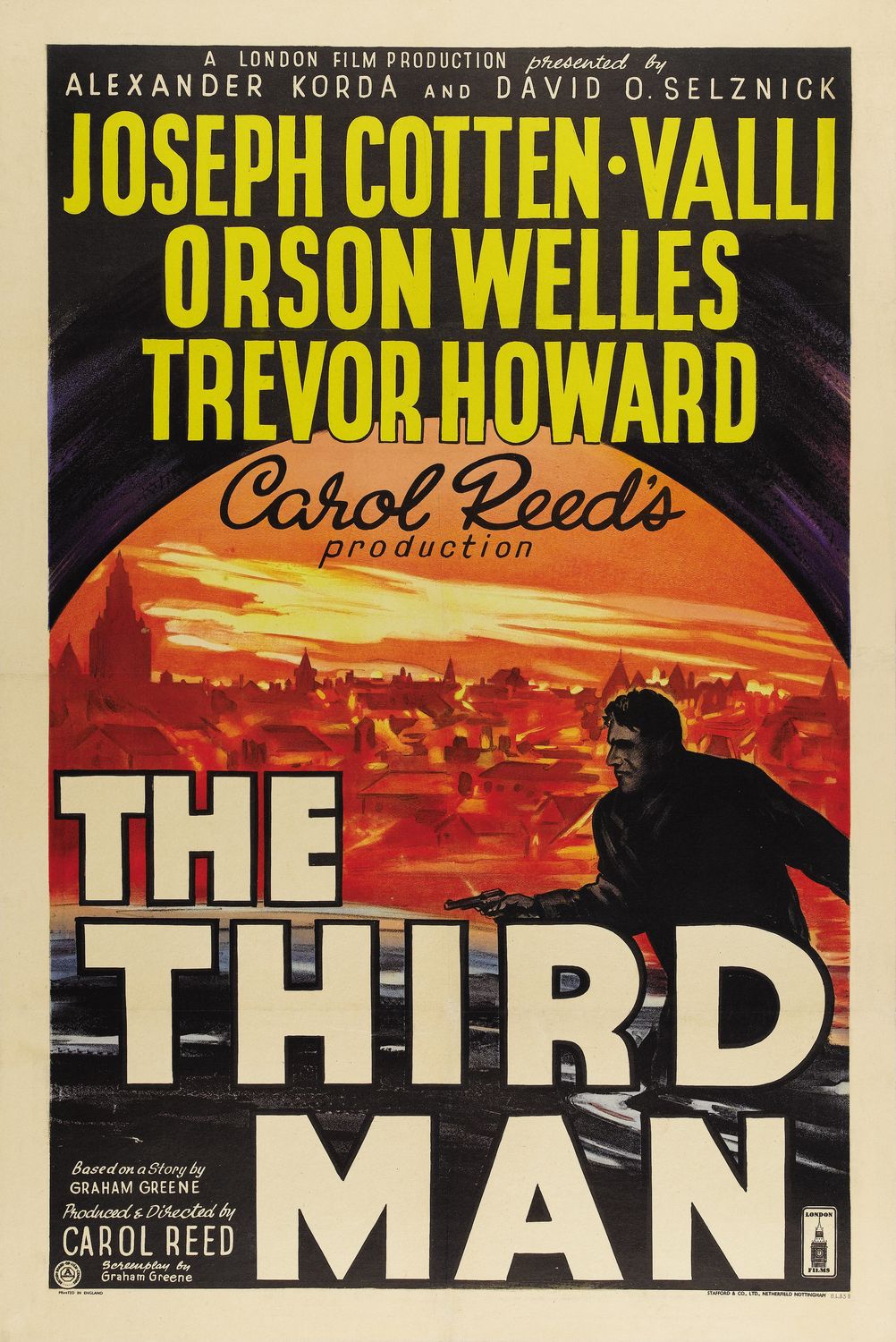
| Poster for noir thriller 'The Third Man' |
'Dead Living Things' is the art house music video that I chose to analyse. It was released under the Warp Records label who have been known to produce unusual acts and emerging talent, particularly in the electronic and techno genres, with art house style videos. For example, one of Warp Records earliest signed acts was Aphex Twin who are known for their unusual style of music and accompanying music videos directed by Chris Cunningham. Thus Warp has been known to sign up and coming bands with an original or unique sound, much like 'Jackson & His Computer Band'.
When looking at 'Dead Living Things' its obvious that it gets its influences from film noir and neo-noir, as well as the thriller genre. This is evidenced by the generic conventions throughout the video, such as the various uses of chiaroscuro lighting and references to femme fatale characters. Gunther Kress' defines genre as 'a kind of text that derives its form from the structure of frequently repeated social occasions with its characteristic participants and their purposes.' Applying this theory to 'Dead Living Things' reveals that the video explicitly references film noir and the thriller genre, showing that it does fall into Kress' theory of genre due to the way that it establishes itself through generic conventions. In another way, the video forms its genre through repeating the elements of film noir so that audiences know what to expect and can immediately place the music video into a familiar genre due to the conventions of that genre. For example, the title is revealed in the opening few seconds of the video; the style and font is quite reminiscent of the titles on posters for noir thrillers, especially when compared to the poster for 'The Third Man'. This shows that 'Dead Living Things' could already be paying tribute to its influences by keeping with the style of the times. Referencing back to Kress, the audience can identify the genre of the music video immediately due to the repetition of the characteristics of the posters of the noir genre.
Another example of where the music video replicates the noir genre is in the frequent use of the femme fatale characters. Femme fatale's are a generic convention of many noir thriller films, appearing in films such as 'Gilda' and 'Double Indemnity' and are defined as a mysterious and seductive woman whose charms ensnare her lovers in bonds of irresistible desire, often leading them into compromising, deadly and dangerous situations. In 'Dead Living Things' the close up shot creates an emphasis around the legs of the female character, which appears to be covered in blood. The blood references the danger and deadliness of femme fatale's and the fish net stockings represent the seductive side, reinforcing the generic representation of woman in the noir thriller genre. The use of the femme fatale archetype in the music video is illustrating Kress' theory of how genre is formed through characteristic participants (being the femme fatale) and their purposes (being the ability to be seductive and deadly). In instances, the video also utilises the frequently repeated use of the female body to attract a male audience. For example, the femme fatale character is dressed in a leather coat, stockings and heals; this seems to objectify the female body, reinforcing the generic characteristics of women in music videos (i.e provocatively dressed). An even more explicit example is the fully nude female character posing for the male character towards the end of the music video. This scene could be interpreted as voyeuristic, as the male character is simply observing the female form, and the gun suggests that he is perhaps not meant to. This not only provides evidence for Kress' theory of frequently repeated participants and their purposes, but it also links with Goodwin's theory that music videos often contain voyeurism of the female body.
 |
The femme fatale in 'Dead Living Things' being held/grabbed,
this could be showing the 'bonds of irresistible desire'
that the femme fatale can have over her lovers |
 |
| Femme fatale archetype in 'Dead Living Things' |
 |
| Gilda, played by Rita Hayworth |
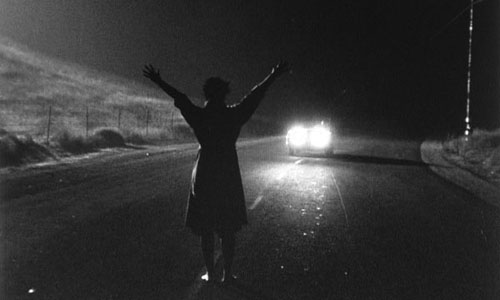
Another example of noir conventions is the car head lights in the dark, providing chiaroscuro lighting. The car shown in the opening section of the music video appears to be from the 1940's, immersing the audience in the time of which the video appears to be set whilst the artificial light seems to heighten the action. Similar shots can be seen in the opening scenes of 'Kiss Me Deadly', a noir thriller film from 1955. Another character from the music video that evidences Kress' theory is the male character arguing with the female character; his costume, consisting of a trilby and an overcoat, is quite generic in terms of the male characters in film noir, as they are often playing detectives or private investigators. By dressing up the male character in this way the audience are able to recognise the music video as being part of the noir genre, showing that through repeated social occasions genre can be formed.
 |
| Car headlights from 'Kiss Me Deadly' |
 |
| Car headlights from the opening of 'Dead Living Things' |
Not only does 'Dead Living Things' draw from film noir, it also appears to be influenced by the horror genre too. For example, the opening shots depict a forest at night with a single car and the moon as a source of light. Forests are often used as locations for horror films due to their huge size and openness (although this contrasts the idea of a claustrophobic location), which leads the feeling of isolation. For an audience, the feeling of being in an open isolated area is perhaps more frightening because there isn't anywhere to hide and the openness means that there could literally be anything in the forest. Furthermore, the lack of light adds tension to the location because the sense of sight of the characters are limited, and so are too the audience to an extent, adding to the feeling of unknown. The forest location can be seen in 'Evil Dead' and 'Eden Lake', both of which fit into the horror genre.
Additionally, the artificial lighting in the forest is made to look like the moon, which could also be a possible link to the horror genre through the themes of werewolves and full moons. The way the light beams through the trees also adds a feeling of suspense and supernatural undertones. The video also shows two dead bodies and a man coughing up blood, all of which could be connotations of the horror genre, in particular the man that appears to have hung himself. If the man had hung himself then he could have been in a dark place or possibly possessed, linking with the generic plot lines of many horror films such as 'The Exorcist' and 'The Possession'. Forests are appropriate locations for horror films, particularly due to the events that take place in some forests in real life. For example, Aokigahara is a forest in Japan that is a notorious suicide spot, with around 100 suicides occurring each year and the forest has long been associated with death. This links together with the forest location and the shot of the man hanging. These events show that the music video has obtained its genre through repeating social occasions, validating Kress' definition. Furthermore, the use of generic conventions, particularly from the noir thriller and horror genres reflects Nicholas Abercrombie's definition of genre, being that 'genres permit the creation and maintenance of a loyal audience which becomes used to seeing programmes within a genre. An audience that are familiar with noir, thrillers, neo-noir or horror films would be able to identify straight away with the video due to being used to seeing similar characteristics and conventions from other media texts, films especially. Therefore the video does a good job of promotion because it will attract a loyal audience who expect to see similarly creative videos for Jackson & His Computer Band's future tracks and productions.
 |
| Forest location with moon lit trees in the opening of 'Dead Living Things' |
 |
| Forest location in 'Evil Dead' |
 |
Cut to man seen hanging as the lyrics "gold is dead" are sung,
referencing Goodwin's theory of matching lyrics to visuals. |
Applying Kress' theory to the video for ASAP Rocky's 'Peso' is a little more straightforward due to the way that if follows the generic construction of rap/hip hop videos. This means quick cuts, handheld camera shots, frequent close ups of the artist, lavish jewellery, saturated colours and the objectification of women. Audiences have come to expect these sorts of videos with generic conventions from hip hop artists due to the repetition of characteristics, particularly as hip hop started to become more about commercialism that the music itself, with the subject matter of songs becoming mostly about money, cars and designer brands. This is certainly the case for a large body of mainstream hip hop today, although underground artists still represent what hip hop truly is. The music video for 'Peso' evidences the generic conventions of rap videos throughout the whole of the video. For example, the first opening shots show only the wrists of the males in the video, but even then emphasis is placed on their gold watches and jewellery. The majority of the camera shots are handheld, giving the video a sense of realism or documentary, perhaps hinting that the artist has come up through a struggle, ASAP Rocky was selling cocaine by the age of 15, and the area he grew up in (Harlem) was and still is a dangerous place. The use of a handheld or 'shaky' shot is a generic convention in rap videos and can be seen in numerous productions. For example, handheld camera shots are utilised in 'Nuthin But A G Thang' by Snoop Dogg & Dr Dre and DJ Premiere ft. KRS-ONE, Rakim and Nas 'Classics'. This shows that the video has firmly placed itself in the hip hop genre through the use of frequently repeated camera shots, almost always depicting close ups of the artists themselves.
 |
Close up shot of ASAP Rocky's grills,
symbolising his wealthy status |
Throughout the video there are several close ups of the artists jewellery and designer clothes, something which is often frequently repeated in hip hop videos as it shows the audience the artists wealth and their ability to spend it on expensive material possessions. It has become common for rap artists to wear a lot of gold as it acts as symbolism for wealth, and for rappers this is particularly important in attracting women. Furthermore, the mise en scene of many of the shots in the videos are often dominated by two things; one being half naked women and the other being African American males. In the video for 'Peso' there is a surprising lack of women being objectified (the lyrics more than make up for this) but ASAP Rocky keeps this generic convention in other videos such as 'Goldie'. Therefore, in a way, 'Peso' doesn't seem to follow the generic convention of objectifying women, like a large number of hip hop videos do, but the artist himself does in general. However, in contrast to this the video for 'Peso' often has a mise en scene dominated by African American males; this could be connoting the fact that hip hop is a predominantly black genre and its roots are firmly implanted in to African American culture, especially as it began in Brooklyn and Harlem. Furthermore, the domination of the mise en scene could also be to give the idea of power and intimidation of gang culture that is often associated with the hip hop genre, New York in particular. Through the use of the symbolism of gang culture and the domination of the mise en scene by African American males, the music video is associated with the hip hop genre due to the generic characteristic participants and their purposes. This can be evidenced by similar shots appearing in a number of different hip hop videos such as 'Survival of the Fittest' by Mobb Deep and 'Fight Music' by D12, the latter focusing particularly on gang culture. The video also depicts the artist shooting dice, an activity often associated with hip hop culture. In doing so, the video for 'Peso' associates itself with the hip hop genre through generic signifiers such as shooting dice, smoking weed and the fast pace cuts of numerous close ups of the artist. In addition, the music video follows the generic convention of hip hop music videos by including a lot of saturated colours in the mise en scene. For these reasons, the video for 'Peso' can be considered explicitly generic of the hip hop genre due to the way that many of the videos share similar characteristics and participants, thus Gunther Kress' theory can be successfully applied to the music video.
 |
Erik B & Rakim in the video for 'Paid in Full'
wearing golden chains to show wealth |
 |
| Shot from 'Peso' showing ASAP Rocky in a mise en scene dominated by males, most of which are topless. This is slightly peculiar considering rappers often discuss numerous sexual relations with multiple women in their lyrics, despite being surrounded by half naked men. |
 |
| ASAP Rocky shooting dice in the video for 'Peso' |
 |
ASAP Rocky smoking weed in the video for 'Peso',
a generic convention in the hip hop genre |
Genre, as defined by Denis McQuail 'may be considered as a practical device for helping any mass medium to produce productions consistently and efficiently and to relate the production to the expectation of its customers'. In terms of music videos, this would be producing the video in a certain way so that it has maximum appeal to the target audience as well as meeting the expectations of that target audience in terms of the generic content. When a music video is released it will be under a certain genre, therefore the audience will know what to expect from the music video due to the genre label that it has been put under, this relating to part of McQuail's theory that addresses the making of consistent and efficient productions. Furthermore, it takes into consideration the commercialism of the music industry, in some genres more than others (hip hop being one of them), and the way that music videos are used to promote commercialism with certain brands and objects, such as cars and jewellery.
The music video for 'Dead Living Things' doesn't exactly conform to a particular genre, however, electronic music videos usually have more of a creative or art house style and so it could be considered that in some ways the music video for 'Dead Living Things' is to be expected coming from that genre. In other words, it is generic in the way that the video is different and creative because many music videos for electronic tracks are just that. However, in relation to McQuail's definition of genre, the video doesn't really conform due to the way that it has been constructed; there isn't really any obvious product placement or commercialism and the video itself is quite an original concept, it isn't very generic. The video seems to be focusing more on the actual aesthetics and themes in the video rather than it's ability to sell to as wide a target audience as possible; although by creating such a well executed production, the video could have the potential to be appealing, just perhaps not to a large market.
The music video is quite sophisticated in the way that it references film noir and thrillers, thus it may be trying to target an older audience as it wouldn't appeal to the average teenager, which is where a lot of music videos, particularly rap and pop videos, aim for. For this reason it is quite explicit that the aim of the video isn't really to be a commercial success or to continue in a line of similar music videos that are what a typical audience expects. In fact, 'Dead Living Things' goes the complete opposite direction, it is exactly what the audience aren't expecting, which is why it is such a captivating production. The reason that I chose to use the music video for this case study is because it was vastly different from the other typical music videos that I had seen, it is not meeting the expectations of its customers, thus it doesn't fit with McQuail's theory. However, it is a successful music video nevertheless. Once again, there are instances where the music video may be trying to gain access to a particular audience through the use of the female body, as there are several female characters that represent the stereotypical archetypes of women in music videos, especially the nude female towards the end of the video.
 |
| Voyeuristic shot of the nude female character smoking a cigarette. |
The video for 'Peso' seems to be targeting a particular audience, or subculture/tribe, with the way that the artist and his accomplices are dressed. As Hebdige maintained, a subculture is the meaning of style; individuals come together through a common interest in style, meaning things such as clothing, music, dance and drugs. The video certainly provides evidence for this theory, as emphasis is placed on the artist and his garments through various close ups, as well as the other males in the background who are similarly dressed. Additionally, ASAP Rocky and the rest of the ASAP Mob (other associated artists) are partially responsible for the promotion of the drug 'purple drank' - a drink consisting of soda and codeine (prescription-strength cough syrup) - through certain lyrics and tracks, in particular 'Purple Swag'. This association with certain clothing brands and drugs has already started to show signs of urban tribes forming with similar styles to those seen in the video for 'Peso'. The fact that the viewers of the video can go out and buy the same, or similar, clothes to those in the music video makes it more appealing for the target audience and is also another way that the artist can be represented by his fans. Furthermore, the audiences themselves form their own identities around the way that certain artists like ASAP Rocky dress and act; this can be linked to Maffessoli's theory of urban tribes. Urban tribes are micro groups of people who share common interests in urban areas. For example, the members of these urban tribes tend to share similar world views and dress patterns; this description fits the style depicted in the music video for 'Peso' and those influenced by it perfectly. Therefore, the music video is successful in further promoting the artist and the track because the audience are much more able to identify with the artist through similarities in dress sense and behaviour.
 |
ASAP Rocky and the extras in the video seen wearing similar baggy clothes
with familiar brands, such as Supreme, Adidas and Black Scale |
 |
Close up shot of ASAP Rocky's trainers,
with the Adidas branding explicitly obvious,
placing emphasis on branding and commercialism |
 |
Another close up/mid shot of ASAP Rocky wearing Black Scale,
a brand that has become increasingly popular since the artist began wearing it.
Black Scale has had an impact on fashion with similar brands
such as HBA (Hood By Air) and Pyrex being worn by the mainstream hip hop community. |
 |
Shooting dice in the streets on the video for 'Juicy' by The Notorious Big,
similar to the scenes in 'Peso' |
The idea of a subculture or urban tribe also links in with Abercrombie's theory of genre, because ASAP Rocky fans have come to expect certain thing from the artist and his videos, as well as similar videos within the same hip hop genre. As I have already established, the video is incredibly generic (close ups, quick cuts, jewellery, expensive clothes and saturated colours) when compared to various other hip hop videos, such as 'Juicy' by The Notorious B.I.G.; infact, several shots from 'Juicy' which came more than a decade before 'Peso', has a very similar mise en scene to that of 'Peso', particularly the shots of the artist and the domination of the mise en scene with African American males. The continuation of these generic conventions is what keeps the hip hop fans/audiences coming back to videos from artists such as ASAP Rocky, because audiences are able to recognise elements that were present in older productions from extremely popular artists like The Notorious B.I.G. in newer productions, thus being able to see firsthand how the genre has developed over time. Additionally, if audiences see the music video and like it due to its generic conventions, they are much more likely to want to follow the artist for similar music videos and tracks, creating the loyal audience that Abercrombie mentioned.

What's also interesting is the juxtaposition of the lyrics and the visuals in the video for 'Peso', as ASAP Rocky says "swagger so impressive and I don't need a necklace" which basically means that he has such an impressive style/confidence that he doesn't need jewellery to impress anyone, especially women. However, as these lyrics are spoken there is a close up of a gold necklace in between the artists teeth, before cutting away to another shot showing ASAP wearing the same gold necklace. This contradiction of the lyrics and the visuals can be linked to Andrew Goodwin's theory of music videos, particularly due to his definition of using visuals to either illustrate, emphasise or contradict the lyrics.
In a similar vein to the idea of a subculture in the video for 'Peso', the video for 'Dead Living Things' strongly references the noir style thriller genre and the horror genre because certain audiences who are predisposed to the noir thriller/horror genre will be able to immediately identify with the music video and recognise generic conventions that are defined as being part of the genre. By referencing the horror genre, the music video will be able to tap into the large audience that enjoy horror films due to the various elements of the video that are horror themed. For example, as the audiences watches the video, they may notice that the events happening in the video don't really have any chronological order, there isn't a linear narrative; the video has more of a montage feeling, referencing Barthe's codes, as the text could be interpreted in a wide number of ways. The fact that the events in the video don't really link together creates a familiar feeling relating to the horror genre, where it is common for unusual events to take place that wouldn't usually make sense in the context of a real world. The audience are unable to make links between what they are seeing, leading to a feeling of unease due to the fact that they are unable to piece together an interpretation of a narrative. Another common theme in horror films is to create suspense in order to make the audience guess what is going to happen next - 'the fear of the unknown' - and this applies to the music video too because of the way that the audience are left wholly to figure out what is actually going on, making them feel engaged with the text. Thus audiences who enjoy these elements of horror films will also enjoy the music video, gaining a wider audience and creating more promotion through word of mouth.
A possible explanation for the random atmosphere of the video and the seemingly unconnected events, as the director of the music video specifically named, is David Lynch and his films. Lynch was named specifically as being a large influence to creating the mise en scene of the music video. There are several recurring themes in Lynch's work, leading film critics Odell and Le Blanc to state that "his films are so packed with motifs, recurrent characters, images, compositions and techniques that you could view his entire output as one large jigsaw puzzle of ideas". This would explain the montage like nature of 'Dead Living Things' and the recurring characters, particularly the female character that often breaks the fourth wall (dressed in white with red lipstick). A key theme that is often noted is the dreamlike quality within his works, creating an environment of surrealism and surreal imagery. This can be found in the dreamlike narrative of films such as 'Mulholland Drive' and Eraserhead. Lynch's work also frequently has dark tones throughout and he is known for working inside the neo-noir genre, which would also link in with the music video's darker themes of death and blood as well as the explicit references to noir and neo-noir. It is very clear to see that the director of 'Dead Living Things' took inspiration from David Lynch's working, linking in with Katie Wale's theory of genre that "genre is an intertextual concept". This intertextuality to Lynch's work will also garner extra publicity as fans of Lynch will be able to identify with the music video.
'Dead Living Things' pays tribute to the horror genre with the strange events aforementioned in the previous paragraph. Many of the events seen in the production seem to be based around the horror genre, however, the video is stylistically very similar to the noir thriller genre. The setting appears to be around a dinner party with a reasonably large number of guests. This itself could link in with the horror genre due to the connotations of murder mystery games often played at dinner parties (someone pretends to be the murderer and the rest of the guests have to figure out who the murderer is), however this time the murder mystery game is real (regarding the dead girl in the oven). The horror genre is then further referenced throughout the video. For example, the male character laying on the dirt road in the opening of the video appears to be run over, but actually appears inside the car; this could lead the audience to question if the driver is simply imagining the man, or whether the man isn't actually human, both of which could link in with the horror genre. Perhaps the man was run over, and the figure the audience see in the car is the mans soul, and the driver is death, which would explain his cold appearance. This event then appears to bear no link with the rest of the video, even more so as the location completely changes to a suburban house.
 |
| The male character lying on the road, about to be run over |
 |
| The same man, this time appearing to be inside the car that just ran him over |
Further on, the audience see two women eating spaghetti, again this seems to have no link with anything else in the video whatsoever, reinforcing the idea that the producers of the video intended to create a montage of unusual events and erratic behaviour that would make the audience feel uneasy. In saying this however, the two female characters eating the spaghetti are vastly different; the first hurriedly eating as though she is anxious and the second appears to be more seductive, looking at the character across from her. Again, this is strange because there isn't an explanation, forcing the audience to guess for themselves. Additionally, there is a shot of a man trying to feed spaghetti bolognese to a poster; the figure on the poster is the artist himself (Jackson & His Computer Band) so this could be a reference that only loyal fans would get, acting as additional promotion of the artist also.
 |
The two female characters eating the spaghetti erratically,
with no relevance to the events of the video |
One of the biggest signifiers of the horror genre, and partially the noir thriller genre too, is the woman lying half inside the oven. The audience are supposed to interpret that this women is dead, although its not for sure as there are no visible signs of injury. However, death is a common them in both horror and thriller films and so including it in the music video is a familiar generic convention to fans of either genre. The woman also is also supposed to intrigue the audience, who will most likely try to explain what happened; the body also links in with the idea of the murder mystery game associated with dinner parties, as the body is a mystery. The colour of the characters clothing contrasts the dark themes in the rest of the video, particularly those surrounding death; white is associated with purity, light, goodness, innocence and virginity, it is considered to be the colour of perfection. For these reasons the colour white contrasts many of the themes in the production, especially due to its positive connotations that the video, on the whole, lacks.
In regard to the rest of the mise en scene in the video, black is the dominating colour as it is present in the location/set, costumes and shadows. The colour black is much more appropriate for the overall tone of the music video, as it is associated with power, death, evil, mystery and elegance. Some of these themes are obviously present in the video, such as the idea of death represented by the man being run over, the women in the oven and the man coughing up blood. The femme fatale character is also wearing black, connoting elegance and power but also mystery and death. Another unusual use of colour is the mirror image/repetition of the male character sitting whilst the female character kisses his ring; his double is tinted red, and this red hue transfers over to the camera shot of the female character, implying a POV shot from the male character. The act of kissing a ring could symbolise submission to the authority, this is reinforced by the eye line between the two characters; the female shown from a high angle and the male shown from a low angle, making clear the power balance. The red colour could be connoting evil and the devil, as the colour red is particularly associated with the latter, this could also be a possible explanation for the male characters doppelgänger; its as though he has a conscience that looks down on him. The colour red is again shown in the blood coughed up in the sink, and the male character looses the power that he previously possessed in the earlier scene. All of these elements are familiar to audiences of the noir thriller genre and especially the horror genre, but perhaps not so much to the fans of the tracks genre. This means that the video is aiming at an audience that identify with films more than music.
 |
| Male character appearing to feed the poster of artist 'Jackson & His Computer Band' |
 |
| Female character kissing the ring of the male character, this could be connoting the rank of the two characters, the man being of a higher status. The act also has sexual connotations, reinforcing the misogynistic representation of women as sex objects. |
 |
| The man shot from a low anne, symbolising power |
 |
| The red tinted version of the male character, looking down in a disapproving manner |
 |
| The red hue is then transferred on to the face of the female character, indicating that the shot is a POV of the male character |
 |
| The male character then runs to the sink, coughing up blood |
In several points throughout the video for 'Dead Living Things', the characters break the fourth wall, which refers to the boundary between the audience and what is happening on screen with the actors/characters. This is achieved by the way that the actors directly look in to the camera as if they are addressing the audience themselves; most of the time these shots are from a worms eye view/very low angle, placing the audience below the characters in terms of power or status, as though the characters are looking down their noses at the viewer. The way that these characters look at the camera, and consequently the audience, appears to be very voyeuristic as the expressions seem as though the audience are intruding on something. This could be another possible reference to Goodwin's theory of music videos, in which emphasis is placed on the idea of looking or voyeurism (watching something taboo that you aren't meant to), however, this time the audience are the voyeurs rather than the characters. Placing the audience in the shoes of the voyeur adds to the general feeling of uneasiness that the video gives, as nothing really makes sense in the world that is created by the production.


In terms of music, music videos and genre there are two categories that a music video can fall in to regarding the source of influence for the production. As demonstrated by the music video for 'Peso', music videos can obtain influence directly from the track in order to promote, staying with the genre of the song and all of its generic conventions. On the other hand, the music video can have nothing to do with the genre of the track, instead drawing from other areas of media such as film or TV. In this way, music videos are cross media texts as they can draw from several areas of media in order to establish genre and narrative. This second definition represents the video for 'Dead Living Things', as the track itself is harder to put into a specific genre than 'Peso' and so instead of trying to follow generic conventions regarding the genre of the track, the music video takes influence from films rather than other music videos for tracks of a similar genre. Both of these ways of using genre work in terms of selling to an audience because they are so different, therefore cater to different audiences. For example, 'Peso' is obviously a hip hop video because the production draws from the track and the genre, and in doing so it sells the artist to the audience through the use of generic conventions that the audience are familiar with. This is a common theme in several other genres too, namely pop, where the videos are extremely commercial in style and are more about making money and selling. In contrast, videos like 'Dead Living Things' seem to use genre in a completely different way, focusing on creating meaning and a genuinely intriguing narrative which also works in attracting audiences due to the originality of the production. Furthermore, by using intertextuality, music videos that take influence from other genres create another layer of meaning that audiences can spot, thus strengthening the promotion of the track and giving audiences something to talk about, leading to more word of mouth and better publicity.
currentVote
noRating
noWeight




_03.jpg)


 What's also interesting is the juxtaposition of the lyrics and the visuals in the video for 'Peso', as ASAP Rocky says "swagger so impressive and I don't need a necklace" which basically means that he has such an impressive style/confidence that he doesn't need jewellery to impress anyone, especially women. However, as these lyrics are spoken there is a close up of a gold necklace in between the artists teeth, before cutting away to another shot showing ASAP wearing the same gold necklace. This contradiction of the lyrics and the visuals can be linked to Andrew Goodwin's theory of music videos, particularly due to his definition of using visuals to either illustrate, emphasise or contradict the lyrics.




 Myself and the other member of my group discussed location ideas with our teacher, and decided that the American Embassy would be an ideal location to film due to the connotations of the building in regard to politics and the numerous protests that took place outside the building, including the Anti-Vietnam war demo in 1968. We also planned to use this location for the print production/CD cover part of the coursework, thus we took several shots of our actor outside the embassy. The building itself probably has the most intimidating appearance out of all of the locations we shot in, with its vast facade and golden eagle. The eagle and flag acted as symbolism for the corruption and government of the United States, particularly in the way that the government has control over the minorities in order to benefit themselves. Whilst shooting at this location, we were questioned by the police and the embassy security about our intentions and what we were filming. The security were enquiring whether we were filming their security cameras, security booths or their guards before contacting the police to come and take our details. This high level of security evidenced the reputation of the building and the suspicions/presumptions of the inhabitants.


