I began by constructing an audience profile detailing what I would expect the target demographic of my productions to be like. This would help me to envision the target audience and the way in which they would be thinking, allowing me to tailor specific parts of the productions in order to attract this target audience. Due to the genre of the track and the corresponding productions, the target audience could be said to be quite niche; Trip Hop and Spoken Word aren't mainstream genres and so the audiences they reach aren't as wide, meaning I had to target a niche audience. This being 18-25 (originally 18-30, however, this seemed like too wider gap) year old white British males, who are well educated and would most likely come from a middle class or lower-middle class social background. The package also has the potential to reach/appeal to a wider audience who are concerned about the lack of equality in society, whether they be in the same age bracket as the target audience or outside the bracket.
John Fiske disagreed with the theory that mass audiences consume the products they are offered without thought, instead arguing that audiences with various social backgrounds and identities allows them to receive texts differently. This theory describes the power that the audience have over the media, rather than the media over audiences, thus I thought it was important to consider the power of our audience (and their social backgrounds/identities) in relation to the productions constructed and they ways in which the themes could be read by audiences. Regarding this, receiving audience feedback on rough drafts of my productions has allowed me to make changes based around the points raised, supporting Fiske's theory that audiences hold a significant power, and thus the productions become more appealing to the audience.
According to Blulmer and Katz's theory regarding Uses and Gratification, my productions will primarily be used for 'personal identity - finding yourself reflected in texts, learning behaviour and values from texts'. This is most probably due to the social commentary aspect of the music video and print productions with the aim to convey a message about social inequality, meaning that audiences who read the message will learn values from the productions. Some of the audience members may also find themselves reflected in my productions, particularly in the situation of the protester character, as he represents the lower-middle class within society.
Music Video
In order to obtain feedback for the music video, I gave out questionnaires to classmates to fill in; this was an appropriate way of gaining audience feedback because the members of class fit the audience profile in one way or another. For example, everyone is within the target age range and there was a mixture of female and males, as well as a mixture of ethnic backgrounds. This meant that the feedback would come from a wider spectrum of audience, perhaps highlighting areas that may not have been otherwise noted.
When looking at the results of the questionnaire and focusing around the answers based on differences in gender I was expecting to see the male participants to rate the music video higher, as the target audience was primarily male due to the use of the one performer being male. This means that a male audience would ideally find it easier to identify with the characters, whereas females wouldn't be able to identify as easily, resulting in lower scores regarding enjoyment and attention. This seemed to be partially reflected in the questionnaires, with 2 out of 6 female participants rating 4 out of 5 regarding enjoyment; whereas only 1 male participant rated the enjoyment factor 4 out of 5. Furthermore, when looking at the second question regarding attention, 3 out of 6 female participants rated 4 out of 5 in comparison to the male participants, who rated attention 5 out of 5 across the board. While it is worth noting that in this format of feedback there were more female participants than males, it still shows that of those who watched the music video, the general conclusion is that the males rated the enjoyment and attention of the music video higher than the female participants, perhaps suggesting that the production did indeed appeal more to a male audience.
The results regarding questions 3 and 4 were slightly more equal, with every participant apart from one male rating the camera work and editing 5 out of 5. Furthermore, two females rated the standard of mise en scene 4 out of 5, whereas every other result was 5 out of 5. This would suggest that both genders were able to appreciate the technical aspects of the production and the way in which the music video was constructed, but that the representations and personal gratification were aimed more towards a male audience. The slightly lower rating of standard of mise en scene by two of the female participants could advocate the notion that the unglamorous, and sometimes dull, locations aren't intriguing to a female audience. However, this is simply an assumption and for some male audience members the business like locations could seem extremely unappealing also, thus affecting the standard of mise en scene.

 The above table displays a culmination of data from the questionnaires - specifically the first 4 questions. The fact that neither one of the questions received a rating of under 4 shows that the music video was extremely successful in appealing to the target audience, showing that the creative decisions made during the planning and filming process paid off in attracting the correct audience. This is especially displayed in the response to questions 1 and 2 regarding audience enjoyment and whether the production held the attention of the audience. Both of these questions were scored highly, showing success amongst the target audience. However, question 2, regarding holding the attention of the audience was met with slightly lower scores - with three people rating 4. This could have been due to the slower pace of the video in some places, with shots staying on screen for a longer time period. This was picked up on by Person 7, who said "some shots were too long". Some audience members may have also noticed this too, however, it was not enough to seriously affect audience attention and the hard hitting beat will have kept the visuals moving in order to maintain attention throughout the other parts of the music video. We would have liked to act on the feedback from Person 7 by using more cuts to other footage during the periods of longer shots; however, we simply didn't have enough footage that made sense in terms of the narrative to replace them with.
The feedback from the questionnaires also provided positive feedback regarding the use of split screen editing techniques, with the majority of people identifying the use of split screen/editing as the best feature of the entire production. This was valuable feedback, as it shows that it was the correct decision to make a music video focused around the use of split screen. Furthermore, it also shows that the split screen and editing techniques worked well in creating binary opposition between the two characters, as well as creating a conflict driven narrative as coined by Claude Levi Strauss. "The symmetry between the two split screens was brilliant" and "the concept/editing/shots were so good" suggest the use of split screen as being successful and appealing to the target audience, as well as reinforcing the notion of difference between the two characters through similar camera shots and angles. The highlighting of the split screen aspect of our music video by participants positively references reception theory as based Stuart Hall's encoding/decoding model. This describes the relationship between the text and the audience, with the producer encoding the text and the text being decoded by the reader, with the result being an aberrant reading or a preferred reading. In the case of our music video and the use of split screen to create binary opposition, the audience members decoded the text in the preferred reading, meaning that they understood the concept and agreed with the code.
All questionnaire participants said that they would watch the music video again, suggesting that we have made a music video with a bold statement. The fact that the participants fit the criteria for the target audience reinforces the notion that the music video appeals to the intended target demographic, regarding age. This also shows that despite some shots being too long, the audience was still interested in the concept enough to watch the music video again, perhaps to better understand or interpret the message being conveyed by the lyrics and the visuals. This ties in with questions 11 and 12 regarding genre and the promotion of the band through the music video. All participants answered that the music video successfully reflected the genre of the music, evidencing that we were able to recognise generic conventions of the tracks genre through analysing music videos and utilise them in our own productions in order to make a music video reflective of the style of music. All but one participant said that the video music video successfully promotes the band/group, with the one participant left undecided. This could be due to the lack of any band members/performances in the music video, leaving audiences unsure of whom exactly the band are. However, a striking video does have the tendency to encourage audiences to research bands on Google, leading to promotion of the artist. This effect seemed to resonate with the rest of the participants on question 12.
 |
| Screenshot from the music video, showing the use of split screen to create a conflict driven narrative |
All questionnaire participants said that they would watch the music video again, suggesting that we have made a music video with a bold statement. The fact that the participants fit the criteria for the target audience reinforces the notion that the music video appeals to the intended target demographic, regarding age. This also shows that despite some shots being too long, the audience was still interested in the concept enough to watch the music video again, perhaps to better understand or interpret the message being conveyed by the lyrics and the visuals. This ties in with questions 11 and 12 regarding genre and the promotion of the band through the music video. All participants answered that the music video successfully reflected the genre of the music, evidencing that we were able to recognise generic conventions of the tracks genre through analysing music videos and utilise them in our own productions in order to make a music video reflective of the style of music. All but one participant said that the video music video successfully promotes the band/group, with the one participant left undecided. This could be due to the lack of any band members/performances in the music video, leaving audiences unsure of whom exactly the band are. However, a striking video does have the tendency to encourage audiences to research bands on Google, leading to promotion of the artist. This effect seemed to resonate with the rest of the participants on question 12.
I found that, although the questionnaires above gave sufficient feedback, the answers we received were often not specific enough in terms of the concepts and representations of the music video. For example, we didn't receive any worthwhile answers to questions 8 and 9, with the majority of participants leaving the space blank or simply writing 'no', leaving little to improve on regarding narrative or representations. This could mean that the concepts and their deliverance through the use of split screen was clear to audience members, meaning that there were no aberrant readings from the participants, however, this seems unlikely as there must be elements that are not clear. The questionnaire was useful in providing numerical data from audience members, however, these numbers represent little information about the actual responses to the music video. For these reasons, I decided to create my own questionnaire on Microsoft Word by including some of the questions from the original questionnaire, some altered questions and some new questions. Therefore, the new questionnaire was more specific to our music video and was able to provoke more of a thoughtful response from audience members/participants.

As I had already gained feedback from the target audience, I decided to gather some information from a wider audience in order to get a different viewpoint on the music video and its themes, especially as those whom previously gave feedback were classmates and therefore had a predisposition to our work. Getting feedback from an age range outside of the target audience also highlighted areas that may not have been picked up on by the participants in the target demographic due to not having as much life experience or knowledge around social class/equality.
The participant in this questionnaire suggested that there were scenes in the music video that were 'emotive' and had the capacity to engage audience to really think about the connotations of the imagery. This is again referenced in a further question, in which the participant said "I felt there was a 'story' but it was subtle. It made me think." This links positively with my earlier prediction that audiences would most probably use our music video for 'personal identity' in terms of uses and gratification, as the music video evoked an emotive response in this participants answers, causing her to actively think and engage with the text. The subtlety of the story as perceived in this questionnaire could be leaning towards an aberrant reading, as the concept is meant to be bold and obvious; however, provoking audiences to think and engage with the narrative in light of their own personal experiences could link with the idea of audience power, as discussed by Fiske.

The screenshot above shows a question and a response from the participant above, displaying an element of an aberrant reading. It is assumed that the music video attempts to convey themes regarding difference and "the different walks of life", however, we as the encoders perhaps haven't made it clear that the differences in the music video are meant to be aimed at social class. It could be that the participant is suggesting that the music video conveys issues around moral class rather than social class. This is followed up with "I would not have immediately associated the video with class, but most definitely difference - difference in approach to life which may be due to class or may be due to how we develop views, values and beliefs." This feedback evidences that, although conflict between social class is present within the music video, the idea of 'difference' in general is much more obvious to the reader. The participant also raised a valid point about the underrepresentation of disability in the media, as this minority group is also oppressed within society. However, trying to represent more than one oppressed minority group in one narrative would most possibly be difficult, as the level of detail in which the groups would be represented in would suffer.
A final point that the participant picked up on was the fact that the track sounded American, but the majority of the visuals juxtaposed with this American feeling, due to being shot primarily on location around London and Norwich, giving a strong feeling of Britishness. The political nature of the track made it difficult to move away from the American theme, however, we aimed to incorporate certain symbols of America in order to connote the corruption and imbalance of power, and how this can be linked to similar events that have occurred in Britain, e.g. the scandal surrounding MP's expenses, rather than aiming to represent America. In attempt to depict more themes of Britishness, we replaced a shot of the American flag for the Union Jack in order to represent the inequality in Britain, rather than America. Despite this, the feedback highlights the fact that the connotations of social inequality in our music video could have been made more explicit.
This participant noted that the use of split screen throughout the entire video may have been too much, and that using single screens at certain points in the video may have allowed the audience to focus more on important parts of the narrative, as well as to provide more juxtaposition. This comment contrasts those made by the other participants of the questionnaires, however it raises a good point on how we might have further been able to create binary opposition, linking to Strauss' theory of a conflict driven narrative. We did take in to consideration using a single screen at one point in the music video to signify a crucial/climatic point in the track, however, we could have utilised the technique more often. Referring to my comments above, this participant notes that the representations shown in our music video were suitable for the cause, and that attempting to have representations of more than one oppressed group in society 'would be difficult.' The participant also determined that the single narrative allowed the audience to "use their own intelligence to draw parallels with their own experiences", tying in again with Fiske and the way audiences interact with texts based on their social backgrounds and experiences. By using their own experiences to draw parallels with the music video, audiences could be using the characters as 'empty categories' to fill with their own anxieties and desires, as described by Giroux.
 |
| Example of how we used single screen in the music video to symbolise a climatic moment |
An important point was raised regarding the promotion of the band by the video; the participant felt that it was not obvious that the music video was actually for the promotion of a band, but rather the video was a short film for raising the issue of inequality with the use of a thought provoking sound track. This was most probably the fault of the style in which I sent out the questionnaire, focusing too much on the themes of the music video and the aims of the band rather than the promotion of the band itself. If I had constructed the questionnaire in a different manor, then, as the participant said, the question may have been answered differently, with the video being a successful element of the promotional package.
The participant of this questionnaire noted that the camera work "managed to represent the two opposing personas through their mirror image - almost like a parallel universe." This reflects one of themes that we were trying to create in our music video through the use of the same performer/actor for both characters; using one actor aims to connote the way in which different choices can lead an individual down completely different paths, akin to a parallel universe, as picked up by the 'reader', suggesting a preferred reading in this case. The fact that this participant, along with the others who took part in this second questionnaire, stated that they would or already have watched the music video again suggests that our music video does indeed appeal to a wider audience than our initial target audience, proposing that the representations and construction of the production is widely appealing/engaging and conveys the bold themes well. The participant also picked up critiquing points on some of the camera shots and the opening of the narrative, stating that the first shots in the bedrooms were slightly dull and didn't provide enough impact. We chose to include these shots in attempt to further disclose to the audience the difference between the two sides of the split screen, however, this could have perhaps been made clearer through slightly more vigorous shots depicting contrast in other situations. Additionally, the longer shots that were picked up on by Person 7 in the first set of questionnaires were also noted here as points in which audience members may lose interest temporarily. As previously described, we unfortunately couldn't change this due to insufficient footage from underestimating the amount that we would need to fill two split screen segments for the entire three minutes.
The participant in this questionnaire is another example of an aberrant reading, whereby social class was not represented clearly but moral class was; "I felt that if the video was trying to show social class, then it did not work". Instead, the participant focused on what they felt was the stronger message; how actions and behaviours are what set individuals apart, whereas social class is something that is put upon people by circumstance. This isn't necessarily a negative point, as it encourages audiences to have independent thought regarding the issues and themes raised in the music video, however, it also indicates that we could have encoded the text in a bolder fashion in order to convey the correct or intended message.
In contrast to the previous participant, the participant in this questionnaire found that the music video, after looking the band up, did successfully promote the band. If the music video appeals to the audience enough to cause them to carry out further research into the band, then the video acts successfully as a promotional package, especially as it attempts to represent the ideologies of the band.
The issue of underrepresentation of women was noted by the participant of this questionnaire, who stated, "I'm wondering if including a female character within the concept too would resonate to a wider audience." In terms of being able to reach a wider audience, this is a valid and worthwhile point; however, as the feedback from the first set of questionnaires suggests, the use of only a male character didn't decrease the appeal of the music video to the female members of the audience a drastic amount. Including a female character may well have increased the appeal to a wider audience, but this might also have had a detrimental effect on the way that audiences viewed the overall production, as the opposition/contrast between the two characters may not have been as strong and audiences may have had aberrant readings by focusing on gender inequality rather than social inequality.
The participant also stated that the video, in their case, had to be watched through several times in order to understand the meaning of both stories, as well as to see how they compare and contrast. This reinforces the feedback of using single screens occasionally throughout the music video in order to draw attention to the areas that are most important thematically. It also suggests that audience members may not understand fully the first time around of watching, but that the music video attempts to make a bold and engaging statement, thus attracting audience members to want to watch it through more than once in order to fully understand the messages being conveyed. The representations used in the videos weren't extreme stereotypes and the participant thought this a good point, as the representations of the social classes wouldn't offend the audience members within those groups that we as the producers/promoters are trying to reach.
Print Productions
In order to collect feedback for the print productions, I used to different methods; one method was using questionnaires similar to those used for the music video, and the other was through the use of post-it notes stuck on the physical copies of the print productions, indicating strengths and weaknesses of individual panels.
Print Production Q
The first 5 questions of the questionnaire requested that the participants rate the various different aspects of the overall promotional package in order to determine its success, both as a promotional product as well as a piece of design work. Participants could rate each aspect from 1 to 5, with 5 being the highest rating. In order to view an overall standpoint, I have worked out the average raring for each question thus making it easier to look at the answers comparatively.
1) Does the package successfully reflect the genre of music? - 5
This shows that through analysing and researching the trip hop genre, as well as looking at/comparing various trip hop album covers, I have been able to utilise the generic conventions of the trip hop genre in my own print productions in order to signify the genre. This links with Gunther Kress' genre theory 'a kind of text that derives its form from the structure of a frequently repeated social occasion, with its characteristic participants and their purposes', meaning that audiences were able to recognise the generic characteristics of album covers, in particular trip hop album covers, in my own print productions. The high score suggests that my research in to trip hop print productions was extensive enough to clearly reflect the genre of the music in my print production package.
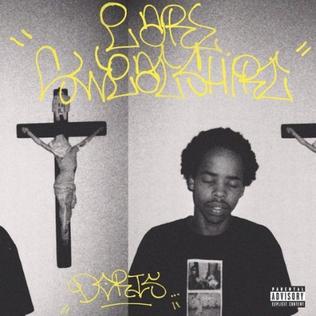 |
| Album cover for "Doris" by "Earl Sweatshirt" |
2) Does the package successfully promote the band/artist? - 4.6
The slightly lower average rating on this question hints that the promotional package may not promote the band as well as it could have. This may be due to the lack of any images explicitly showing the band members themselves, as according to Goodwin artists often appear in close ups in order to create a brand style as well as to satisfy the requests of the record company. However, close up shots of artists for print productions most usually apply to more mainstream genres, such as pop music, in which artists often promote themselves through actual photographs. For example, hip hop artist "Earl Sweatshirt" uses a photograph of himself for the front cover of his album "Doris" in order to create recognition for himself and to create a brand style. However, through my research in to trip hop print productions, specifically album covers, it is clear that it is actually unusual for an artist or a group to use establishing shots of themselves on the album covers, instead opting for creative graphic designs or other such designs instead. For example, "Massive Attack" are extremely well known amongst the trip hop community, as well as the mainstream public, for being one of the standout trip hop groups. They have always used alternative images for their album covers, such as the cover for "Blue Lines", going against the generic convention of mainstream genres, but utilising the conventions of trip hop genre. The clear and bold text used on the "Blue Lines" album cover clearly promotes the band, with the large font making it clear the band name. I have utilised a similar technique for the front cover of my print production by using a large and bold font for the band name, thus promoting "Fold".
 |
| Album cover for "Blue Lines" by "Massive Attack" |
4) How do you rate the standard of graphics, text, finish of advert? - 5
For both questions 3 and 4 I received reasonably high marks, with 4.6 out of 5 for the digipak and 5 out of 5 for the magazine advert. This suggests that the designs for my album panels and magazine have been finished to a high standard, and that the designs also have a strong appeal to the target demographic of the promotional package. This also indicates that images used throughout the digipak and magazine advert contribute to the notion of a coherent promotional package, and that due to the high ratings of graphics, text and overall finish, the productions would be marketable to an audience.
5) How successfully is the Britishness of the package established? - 5
Once again, this area of my print productions received high ratings, suggesting that my print productions successfully represented the notion of Britain, and the importance of representing Britain in relation to the brief. The positive feedback in this section could be due to the use of well known locations in London that would be recognisable to a British audience, such as the American Embassy and a London Underground station. These locations are intrinsically linked to Britain, and will therefore be immediately recognisable to the target audience (young British males). The representation of Britishness is more successful in the digipak than in the music video, in which it was pointed out that the track sounded very American, whereas the visuals where quintessentially British, leading to confusion for some audience members. The music video even contained some symbols of America briefly, whereas the digipak contains no symbolic references to America, and is thus representing Britain successfully.
 Questions 6 and 7 are testing the degree of successfulness in which the promotional package would encourage the participants to buy the digipak/go to an event by the artist. All participants in the questionnaire answered yes to both of these questions, thus suggesting strongly that the print productions successfully market the artist, as well as showing that they have an appeal to the target audience. The high ratings on this question also provide further evidence for the quality of the design of the print productions, as for participants to be persuaded to buy the digipak or got to an event, they need to be impressed by the promotional package on offer. Additionally, if the print productions are successful in encouraging audience members/participants to buy the digipak/go to an event by the artist, "Fold" will gain recognition and notability through word of mouth.
The following question gave the participants the opportunity to offer any criticisms of the print productions in terms of representations, such as age, gender, ethnicity and British culture. However, all participants once again found the print productions to have no issues or offensive content, similar to the feedback of the music video. I would expect that if there were any criticisms of this element of the productions, they would be similar to those raised in the second round of questionnaires that I sent out; issues could be raised regarding representations, however, trying to fairly represent all oppressed groups in society would prove even more difficult in the print productions, and so creating a single narrative for a wider cause is seen to be acceptable. The participants were then asked to identify the strongest features of the ancillary tasks (i.e. the digipak and the magazine advert), in which the front panel/panel 1 received positive feedback in terms of being eye catching/unique and having a professional aesthetic quality; something that will help to appeal to audiences as well as sell the digipak. I also received positive feedback towards the magazine advert/poster in terms of design, with the participant stating, "I like the magazine advert - bit like Obama". This is positive feedback as it shows that the target audience is able to decode the implications of the design of the poster in relation to the Obama presidential campaign poster and its frequent use in popular culture, as well as its political connotations. Furthermore, one of the participants commented on the back panel/panel 4 in the way it was composed, stating, "Really like back panel and how the image looks split screen". This shows that the split screen technique has been successfully continued throughout the productions, providing a coherent promotional package. It also proposes that the audience will be able to decode the digipak in the preferred reading, understanding that the recurring motif of the split screen is used to create binary opposition.
In addition to the questionnaires, I received various post-it notes with feedback from 'anonymous' participants; these were stuck on to the physical copies of my print productions, analysing in depth the specific elements and aspects of the digipak and magazine advert. Almost all of the feedback I received from these post-it notes was positive, commenting on the simplicity of the design and how this simplicity reflects the genre. One of the elements of my print productions that was commented on the most was the used of quotes on the promotional postcards and on the inside panels 2 & 3. For example, one of the post-it notes reads, "The idea for the quotes is really good - gets the message out. Impacts the audience" and another read "I like the quotes/stats too - emphasises the political message". This shows that the target audience has a higher rate of preferred readings, understanding that the quotes were used to strengthen the themes of the track and the music video. Additionally, comments regarding the font used for the text and the band name were raised several times, noting that the use of the bold font and contrasting colours, particularly white, made the text stand out, thus promoting the band.


No comments:
Post a Comment